
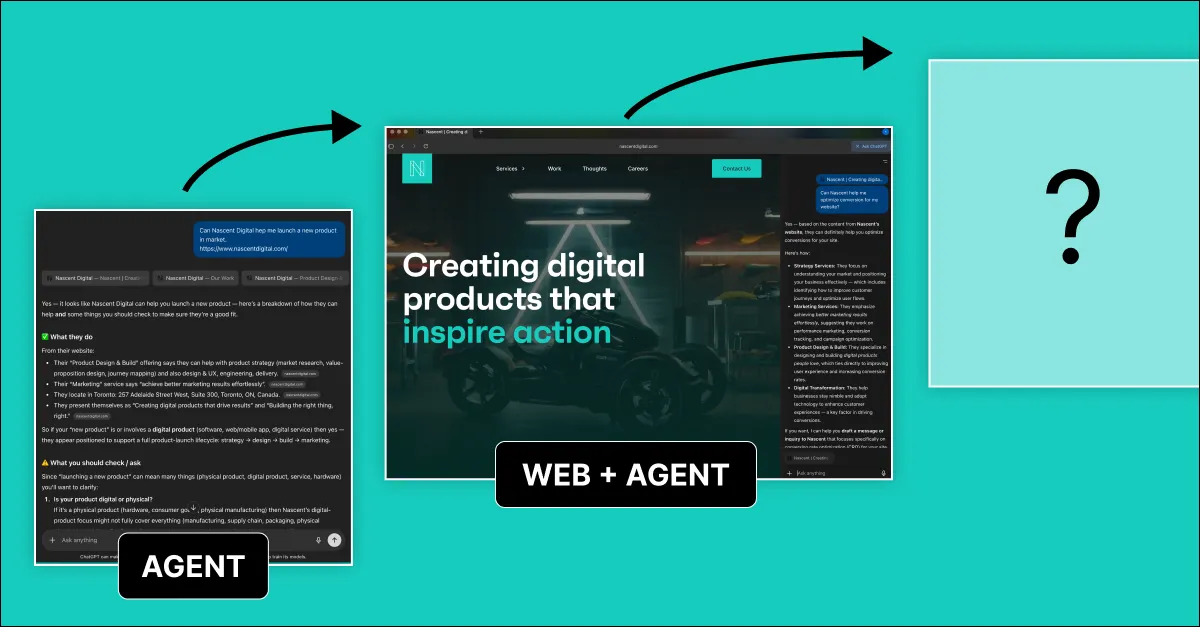
Rethinking how brands exist in the age of intelligent search
Websites aren’t ending; they’re evolving. As AI reshapes how we search, discover, and connect, the web may shift from fixed pages to adaptive systems that listen, respond, and express a brand’s voice in real time. This shift will also change how we design, architect, and collaborate to build digital experiences that feel more fluid and human.
As these shifts take hold, one of the first places we may notice change is in how we navigate. How people find their way through digital spaces, and how those spaces, in turn, begin to guide them.
The nature of search and the shifting role of navigation
Navigation has always helped people find their way. In many ways it’s a visible map of what’s possible. Traditionally, it’s been a visual system: menus and hierarchies that clearly outline every section of a website. This structure sets expectations for what’s available, helping people browse and signalling to search engines what content exists.
Yet as search becomes more fluid (conversational, contextual, and predictive) the boundaries of navigation start to blur. What happens when people no longer explore through menus, but express needs in natural language? When interfaces stop showing everything up front and instead reveal just what’s relevant in the moment?
If navigation once served as the map, are we now designing the compass? And in this shift from showing to responding, what remains essential for people to still feel oriented, confident, and in control?
Data as material: The new building blocks of experience
We’ve long treated content as our design material. We use words, images, and interactions assembled into coherent forms. But data is increasingly becoming part of that foundation. It’s no longer just what informs an experience, but what constructs it.
When content is structured as data, it becomes modular and reconfigurable, capable of being reorganized and expressed in countless ways to reflect intent, context, or meaning. The building blocks of experience are no longer fixed; they are responsive, shifting in real time to meet evolving needs.
These possibilities feel almost endless with each interaction, input, or request generating new expressions and combinations. Which raises a quiet question: how do we organize such fluid systems so they remain interpretable, predictable, and still feel human?
Today

Tomorrow

Machines are robotic. People are not. Machines are astonishing at delivering information. They do it fast, accurately, and without fatigue. Yet information alone rarely compels us to care. We yearn for something deeper, with tone, texture, identity and meaning.
As AI takes on more of the cognitive work, brands may start to hold a different kind of weight. Not just as a marketing layer, but as the emotional and ethical framework that gives coherence to an increasingly automated experience.
If intelligent systems become the new infrastructure, does brand become the human signature within it? How might we express warmth, authenticity, and trust in ways that machines can’t easily mimic?
How we construct and consume websites


